














On April 28, the Peralta Community College District Board of Trustees met to review the current iteration of a districtwide Facilities Master Plan. According to the Division of the State Architect, 40% of all Peralta buildings are considered “deficient,” or the “strongest candidates” for renovation or replacement. The plan also found that a growing percentage of Peralta students are enrolled online.
The district contracted with Sacramento-based consulting firm ALMA Strategies in the amount of a $1.6 million consultant agreement in June 2025 to complete a variety of services, including “support” with the Facilities Master Plan.
The company had previously held contracts with the district to provide planning services for numerous projects related to district facilities in 2019 and 2020.
Peralta will hold facilities master plan listening sessions at the four colleges and district office between May 12 and June 24, according to a districtwide email.
Three representatives from ALMA strategies presented their findings to the board.
ALMA consultant Benjamin Roso said that half of the buildings across the district are in “efficient” condition, according to assessments coordinated by the Division of the State Architect and the State Chancellor’s Office.
38 total buildings, accounting for 40% of the district, were classified as “deficient,” according to ALMA’s presentation. 10 buildings were classified as “adequate.”
The classifications were determined using a tool called a Facilities Condition Index, which determines the condition of a building by dividing the cost of its necessary maintenance or repairs by its current replacement value. The tool is used to support property management.
“The term ‘deficient’ doesn’t mean that we shouldn’t be in this building right now,” District Chancellor Tammeil Gilkerson said during the meeting. “It’s a decision-making tool.”
“It isn’t a question of safety,” ALMA senior partner Shaun Blaylock agreed. “The buildings are safe.”
According to Blaylock, the evaluations are primarily used by the state to ascertain whether the condition of a building merits funding.
The evaluations were determined by factors such as “structural condition, infrastructure, and age,” Roso said.
When asked to explain the reasoning behind the classifications, as well as the specific conditions of each building, Blaylock redirected the trustees to a state database called FUSION. The acronym stands for Facilities Utilization, Space Inventory Options Net and is a database of California Community College facilities that “tracks the condition assessments and develops cost modeling for maintenance projects,” according to its website.
Berkeley City College (BCC) is the only Peralta campus with fully “efficient” structures, according to ALMA’s presentation. BCC’s only buildings are its main campus and the Milvia Street expansion project, which is still under construction.
The report shows that the other three Peralta colleges and the District Office have multiple deficient buildings. The district offices have the overall highest percentage of deficient buildings at 57%.
Merritt College had the highest listed deficiency rate of the colleges at 48%. Laney College had the greatest number of deficient buildings overall with 13.
ALMA’s presentation advised the district to consider renovations, demolitions, or replacements to fix the deficient buildings.
“At a certain point, the cost of bringing [deficient buildings] up to code can make replacement a more practical option,” Roso said. However, he continued, “the District cannot approach every building as though long-term reinvestment is equally viable.”
Any new constructions should be smaller and more supportive of multi-disciplinary use, the report suggested.
According to ALMA’s presentation, Peralta’s building “footprint” is too large to match its current student population and the manner in which students receive instruction, especially as a significant number of students have shifted to virtual learning. This problem has caused a “strain” on the district’s operations, Blaylock said.
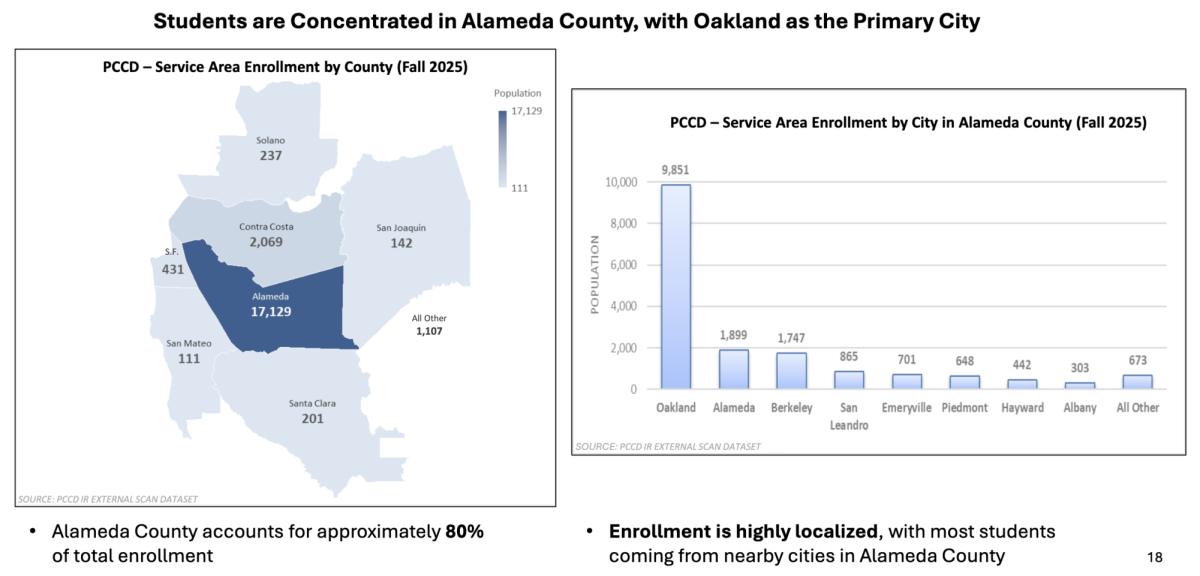
To help determine the best course of action regarding Peralta’s facilities, ALMA research analyst Komal Johl presented an examination of the district’s enrollment patterns.
Johl showed that districtwide enrollment is highly localized to Oakland. Of the 29,669 students that enrolled at Peralta in Fall 2025, 9,851 were from Oakland. Comparatively, students from the city of Alameda—the second-highest population group of Peralta students based in Alameda County that same semester—totaled 1,899.
Blaylock underscored the number of “aging” students at Peralta in reference to Alameda County’s general population, using data from the 2024 U.S. Census. “Students who are above 35 and 40 and older […] [are] your largest population right now,” he claimed.
Roso noted that only 25% of Peralta students could be classified as Full-Time Equivalent Students (FTES) in Fall 2025. The 25% FTES rate is a substantial decline from Fall 2019’s pre-pandemic rate of 28%.
Program demands across the district have also shifted over time, according to ALMA’s presentation. Gilkerson highlighted a growing student interest in Career Technical Education (CTE) programs.
“In many of our [CTE] programs, students can take just the core courses and get hired right away… so they’re not choosing to take the general ed[ucation] portion of that degree program that we offer,” Gilkerson said. “We’re seeing that in some of our data.”
“What we’re seeing across the state is […] students are coming in and wanting to get job growth, workforce development, and so forth,” Blaylock agreed. “That’s becoming a real priority.”
Despite this large local population, Roso observed that a considerable percentage of Peralta’s students have gravitated towards virtual learning. In Fall 2025, online Weekly Student Contact Hours (WSCH) were 125% higher districtwide than they were in Fall 2019, he noted.
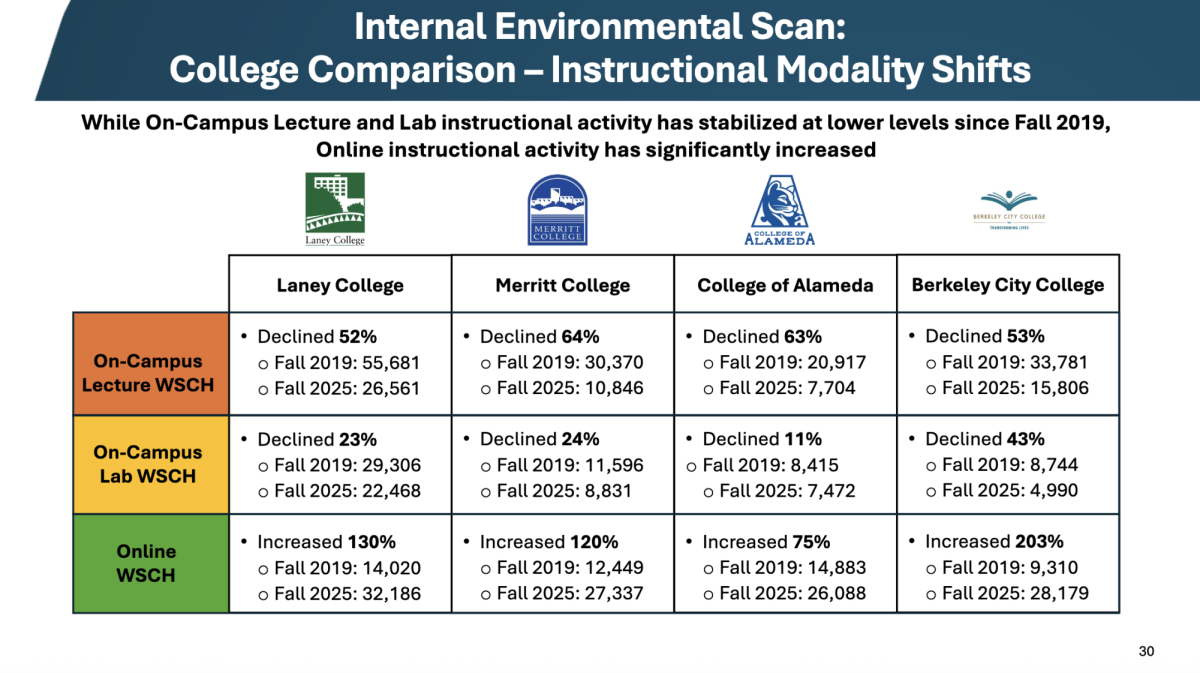
WSCH data is used to determine student participation rates across the colleges. The data is further subdivided into on-campus and online categories to ascertain the effectiveness of different modes of learning.
“[The WSCH data] suggests that the district can […] reduce excess space and reinvest in higher impact environments such as […] space that promotes hybrid and online modalities,” Roso said.
Board President Louis Quindlen disagreed with ALMA’s proposed emphasis on online learning. “If I go to an online class, about 15 minutes into it, I’m ready to throw my computer across the room. And I imagine many of our students are like that also. They do not learn well that way,” Quindlen said. “Who are we serving, and what are they capable of, and how do we best serve them?”
“There’s multiple questions that really have been addressed,” Gilkerson responded. She referenced districtwide “transformation work” as an area in which discussions about virtual learning modalities had taken place.
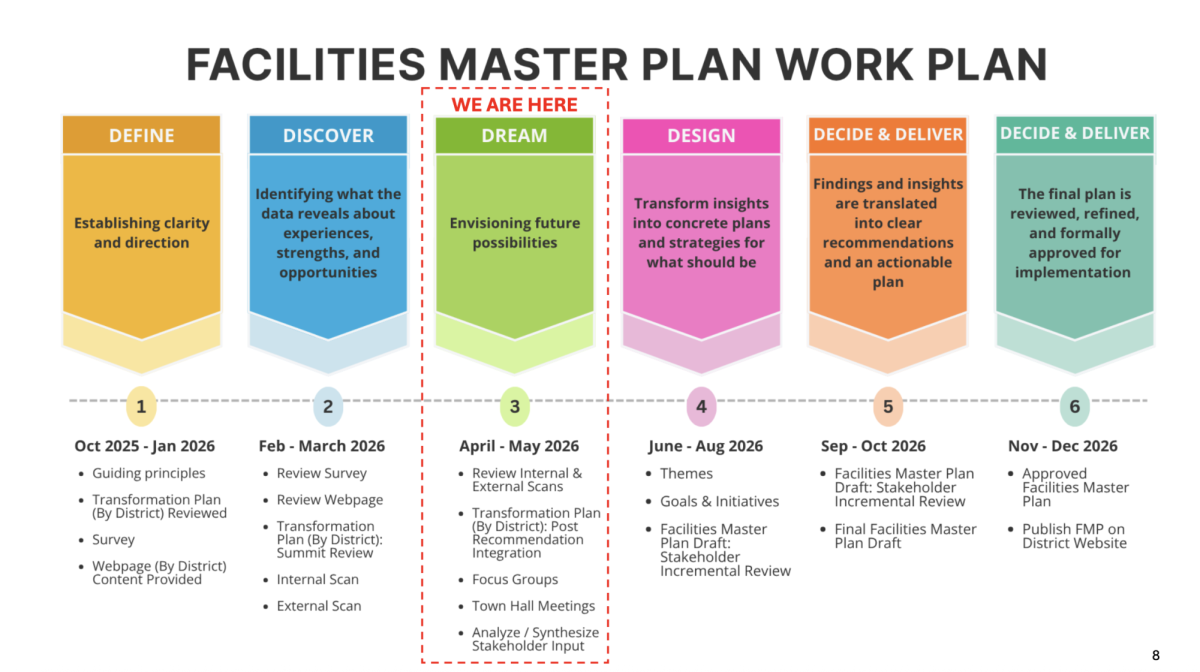
Peralta is currently in phase three of the Facility Master Plan’s six-phase development process, which began in October 2025. According to ALMA’s presentation, the plan should be finalized by December. Its findings will then be approved for implementation.