








As the morning sun peeked over the Merritt College campus on Oct. 29, dancers in gem-embroidered vests and tall feather headdresses lined up to start their choreography. Drumbeats and the rattling of chachayotes began to fill the air as Merritt began its Día de los Muertos celebration.
Each of the Peralta colleges participated in the holiday with colorful altars or community events. At Merritt, the Puente student program hosted a full day of song, traditional Aztec dance, and free food.
The Puente program put on the college’s first Día de los Muertos celebration nearly 20 years ago, Merritt English instructor Isela González Santana said. She is a coordinator for Merritt’s Puente program, and helped to organize the event.
“We kept the tradition, and it kept growing, getting stronger and hopefully even better,” she said.
The history of Día de los Muertos goes back thousands of years. Its origins are often traced to pre-colonial Indigenous traditions in Mexico.
Today, people celebrate the holiday across Mexico, Central America, and parts of the United States to remember their deceased loved ones with decorated altars, candles, and offerings.
Families observe the celebration in early November by building decorated ofrendas, or altars, in their homes. There, they place photographs of their loved ones to honor them and guide them home from the spirit world.
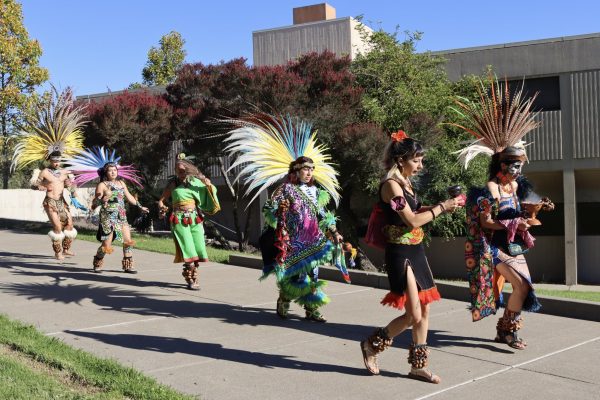
At Merritt, the day began with an Indigenous Danza Azteca, called “The Four Directions.”
The crowd entered a brightly decorated room filled with altars featuring candles and colorful “papel picado,” which are decorative pieces of tissue paper trimmed into ornate designs. The smell of incense filled the air.
Each object on the altar – like candles, water and salt – holds a symbolic meaning to help and guide the spirits of the dead.
After two more danzas, Puente coordinator González Santana invited guests to shout out names of family members who had passed away. Merritt instructor Richard Santana led the attendees in singing a closing song for the event.
Merritt president David Johnson acknowledged the day as an “opportunity” for the community to “think about loved ones, our ancestors, our predecessors […] what they’ve meant to us, how they’ve contributed to the people we’ve become, and how they’re still with us.”
”Even when your loved ones leave you outwardly, they never leave you inwardly,” Johnson said.
After the rhythmic danzas and spiritual songs died down, people from the crowd each added small pieces of paper with the names of their loved ones to a board. They drank hot chocolate with pan de muerto and gave hugs to each other before departing.