














On the Laney College campus, last semester, I walked into the women’s bathroom in the G Complex and I was met with an unexpected visitor – my period showed up early.
I wasn’t prepared for this menstrual cycle. But I thought the menstrual hygiene product dispenser would be equipped with supplies I could use. However, when I pressed the button for a pad or tampon, nothing fell out.
I was frustrated. Was I supposed to free bleed through campus until I figured out where I could get a pad?
I didn’t want to walk around looking for menstrual products, I also didn’t want to ask a classmate because it can oftentimes be embarrassing, so I went on to the next best option: I called my mom. She took time out of her day to drive down to Laney and bring me a bag full of menstrual hygiene supplies. Day saved.
After this experience, I wanted to know where I could find hygiene products on Laney’s campus – in case of another emergency.
Moms can’t always be there, and without the dispensers stocked in the bathrooms, where can Peralta students access menstrual products on campus?
What are the Peralta Colleges required to do?
California community colleges are required by state law to provide menstrual products on their campuses.
California Assembly Bill 367, signed into law in 2021, requires each community college district to provide free and accessible menstrual products on each campus.
The Menstrual Equity for All Act of 2023 expanded on AB 367 and established a federal grant program for higher education campuses to supply free menstrual products.
California Senate Bill 59 requires state-owned buildings to provide free period products in women’s and all-gendered restrooms, and at least one men’s restroom at all times.
Peralta’s Administrative Procedure 5200 states that the mission of the district is to provide equality in educational opportunity by providing health services. The AP was approved in February 2013 and has not been updated since. The text doesn’t mention menstrual health or hygiene products.
Where can I find menstrual hygiene products at Peralta campuses?
I scoured through district websites and searched for key words to learn where Peralta students can find menstrual products on campus. While each campus offers period products, it’s not always clear what they offer.
- According to the Merritt College Basic Needs website, the center offers “hygiene products.”
- At Laney College, the Eagle’s Nest website states that they provide students with “personal hygiene products.”
- According to a Peralta Gems newsletter from Sept. 2025, the Basic Needs Center at College of Alameda offers ‘menstrual products.’
- According to the Berkeley City College Basic Needs Website, students can visit the Basic Needs Center “once per week” for “free hygiene products.”
In an email from BCC’s Basic Needs Center Project manager, Izzie Villanueva, the center purchased hygiene dispensers from period product company Aunt Flow, and continuously purchases pads and tampons. According to payment reports between 2023-2025, the district has paid Aunt Flow at least $22,193.
Under the district’s College Health Services FAQ site, the Student Health Clinic at Laney offers ‘feminine products’ to all Peralta Students.
District response
According to Laney’s Basic Needs Center coordinator, Katrina Santos, when the center runs low on period products, they “typically” let a custodian know and receive new products “that [same] day.”
Santos said that the employees of the Basic Needs Center take it upon themselves to physically stock up the hygiene dispenser in the Student Center, a task that she said is “under the purview of facilities.”
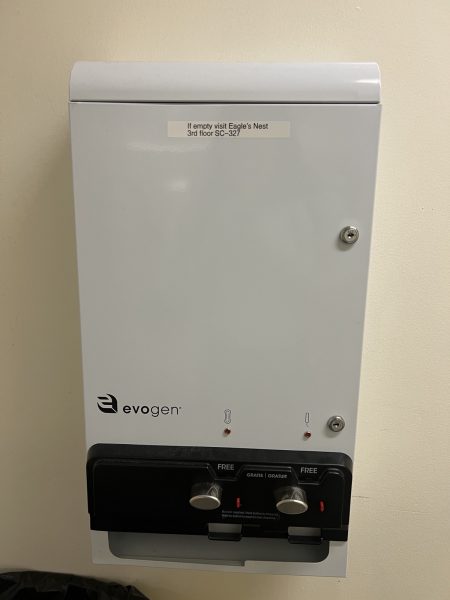
According to Santos, the center does not receive direct funding for menstrual products; when they begin to run low, Santos said they contact the Laney business office.
Laney’s Vice President of Business and Administrative Services, Ashish Sahni, told The Citizen that as of July, the custodial department now reports to the district’s facilities, maintenance, and operations department.
The Citizen reached out to the district’s director of facilities and operations, BC Hoff, multiple times to understand Peralta’s protocols for re-stocking dispensers but he was unavailable for comment in time for publication.
Peralta’s Deputy Chancellor and Chief Operating Officer, Greg Nelson, wrote in an email to The Citizen that stocking the hygiene dispensers “is the responsibility of custodial staff.”
“This is news to me that [stocking the dispensers] has not been happening,” Nelson wrote.
Nelson added that staff will “be reviewing [the district’s] standards” to ensure that restrooms are being re-stocked in accordance with state law.
Between the time I spoke with Nelson and the date of publication, I roamed through the Laney campus checking some of the restrooms. Some hygiene dispensers in the G, A and B quads were stocked, while others were empty.
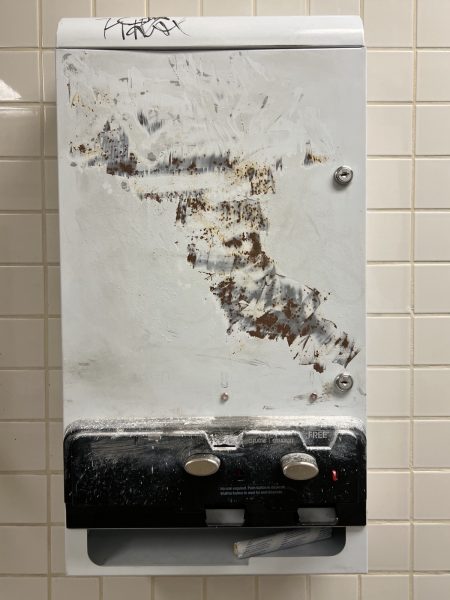
Some dispensers had either tampons or pads while others had neither. Some had pads and tampons sitting in the tray of the dispenser for who knows how long.
Why period product access matters
A 2021 study by medical researchers from the University of Pennsylvania and George Mason University found that 14% of women attending college in the United States could not afford or access menstrual products, also known as facing “period poverty.” This includes borrowing products, using materials other than menstrual products, or using no products at all.
For some of us, the side effects of menstruation can impact our daily life routines.
We deal with painful abdominal cramps, drowsiness, back pain, bloating, and fatigue before, during, and after menstruation. If you add a lack of access to menstrual products to that list, it’s nearly impossible for us to focus on our studies.
We should not have to scour through the internet to know where to access pads and tampons in our colleges. Information about menstruation products should be readily available in restrooms.
Though the district is not violating the law, the lack of information on available products reinforces the social stigma that comes with menstruation.
Too many of us have faced mistreatment for menstruating or misdiagnoses of reproductive diseases. Some of us have been laughed at for staining our jeans, or have been yelled at by our families for not hiding our cycle “properly.”
We are not allowed to speak of it publicly because it’s “disgusting,” or because it makes those around us uncomfortable.
We’ve been called crybabies and bitches, or accused of being on our periods if we happen to get “too angry.”
More than half of Peralta students menstruate – district administrators should ask themselves what role they play in the inconsistencies of menstrual hygiene access, and reflect on how they can serve menstruating students in a way that positively affects our educational experience on our campuses.
The article was updated at 8:00 p.m. on May 6, 2026 to include a correction to the language in the subhead. The original article stated that federal laws required community college campuses to provide students with free menstrual products instead of California state laws.
