















The Peralta Community College District is working to implement a new hybrid safety model that includes bringing police back on campuses. Annual Security Reports offer districtwide insight to how each campus is affected by crime.
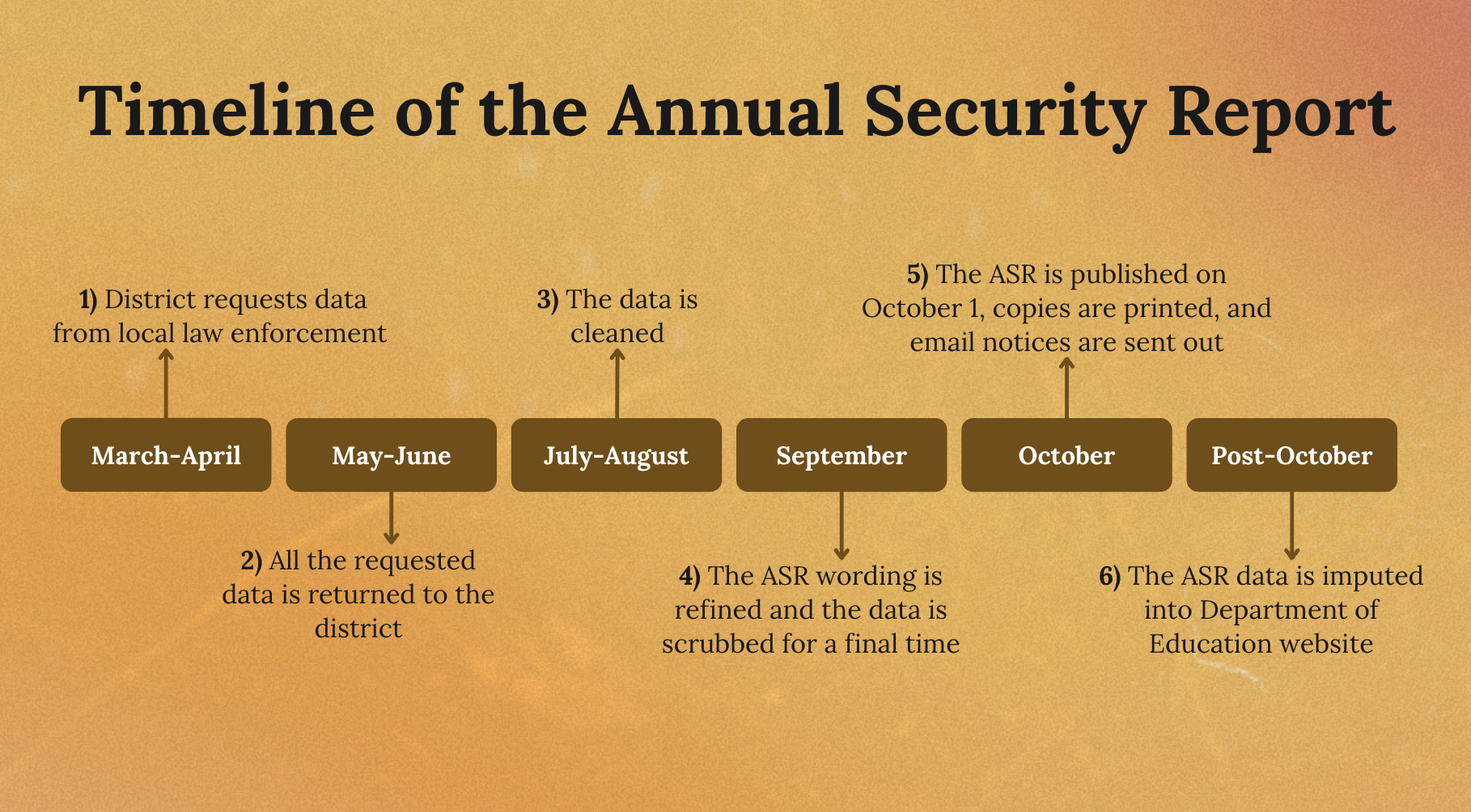
Every year on October 1, the district is required to publish the previous three years worth of data on crime at the district, per the Jeanne Clery Act, in an Annual Security Report. The Jeanne Clery Act is a federal law that brings “transparency around campus crime policy and statistics.”
If the district does not make the October 1 deadline, they could be subject to review by the Department of Education’s financial aid office for noncompliance and could be fined over $70,000 per violation, depending on the department’s findings.
The Citizen analyzed data from Annual Security Reports between 2011 and 2024. Compared to the other three colleges at Peralta, 73.9% of all Clery crimes are committed at Laney College.
Clery breaks crimes down into five categories: criminal offenses, hate crimes, crimes specified under the Violence Against Women Act, and arrests/referral for disciplinary action.
Crimes must occur in specific areas to be counted in the report including on campus, student housing, public property “within campus bounds,” public property “immediately adjacent to the campus,” and “non-campus buildings and property owned or controlled by the organization.”
The annual report also includes policy statements regarding “crime reporting, campus facility security and access, law enforcement authority, incidence of alcohol and drug use, and the prevention of/response to sexual assault, domestic or dating violence, and stalking.”
Abdul Pridgen, the Interim Executive Director of Community Safety at Peralta, is in charge of compiling and submitting the Annual Security Report.
According to the Deputy Chancellor and Chief Operating Officer, Greg Nelson, private security collects the data from police call logs and “synthesizes all that down to what actually meets the Clery requirements.”
Then, Pridgen builds the report and goes through all the data himself, he said. “It’s a one person show.”
The final report is certified by the Chief Operating Officer.
Nelson added that once the new Executive Director of Community Safety, staff, third party security, and dispatchers are hired, the staff will help build the report.
The data
The Citizen broke down the data into three different crime categories: property crime; violent crime; and liquor, drug, and weapons violations- arrests and referrals.
The data published by the district has been collected from multiple sources including the Oakland, Alameda, and Berkeley Police Departments, Alameda County Sheriff’s Office and East Bay Regional Park District Police. The district also collects crime data from its contracted private security partners.
Crime at Peralta affects each campus differently. Laney has seen the most crime out of the four colleges, with the majority being property crime.
In 2020, the Board of Trustees voted not to renew the district’s contract with the Alameda County Sheriff’s Office, following the murder of George Floyd by Minneapolis police.
Between 2020 and 2024, all four colleges saw an overall drop in violent crime compared to years prior. In 2021, there was a spike in property crimes at Laney. In 2024, Laney saw zero violent crimes for the first time in over 10 years.
“It is difficult, however, to isolate any single variable as the definitive cause of the reductions reflected in the Clery data,
What’s the deal with crime at Laney?
Pridgen told The Citizen that Laney has “unique challenges,” since it’s an “open urban campus” and anyone “can just walk in.”
Comparatively, Merritt College is in the Oakland hills and mainly accessible by car, shuttle, or a single bus line. College of Alameda is similarly situated in accessibility. Berkeley City College, though also an open urban campus, has just one entrance and exit to the building.
Laney also has the most enrolled students out of the four colleges with approximately 10,422 students as of Fall 2025. Pridgen said “the larger the number of people that you have [on campus] increases the percentages of things potentially happening.”
He pointed out that, with the last three years of Clery crime data in mind, “relatively speaking, [Laney] is a safe campus.”
“The deployment of resources is based upon the challenges we see in real time, and we make adjustments as necessary,” Pridgen said.
Pridgen said that he has responded to the “unique situation at Laney” by “expand[ing] the use of the PeraltaSafety app, providing training to people on conflict resolution and de-escalation, and changing the way we share critical information by expanding the number of people that can send out RAVE [emergency] alerts.”